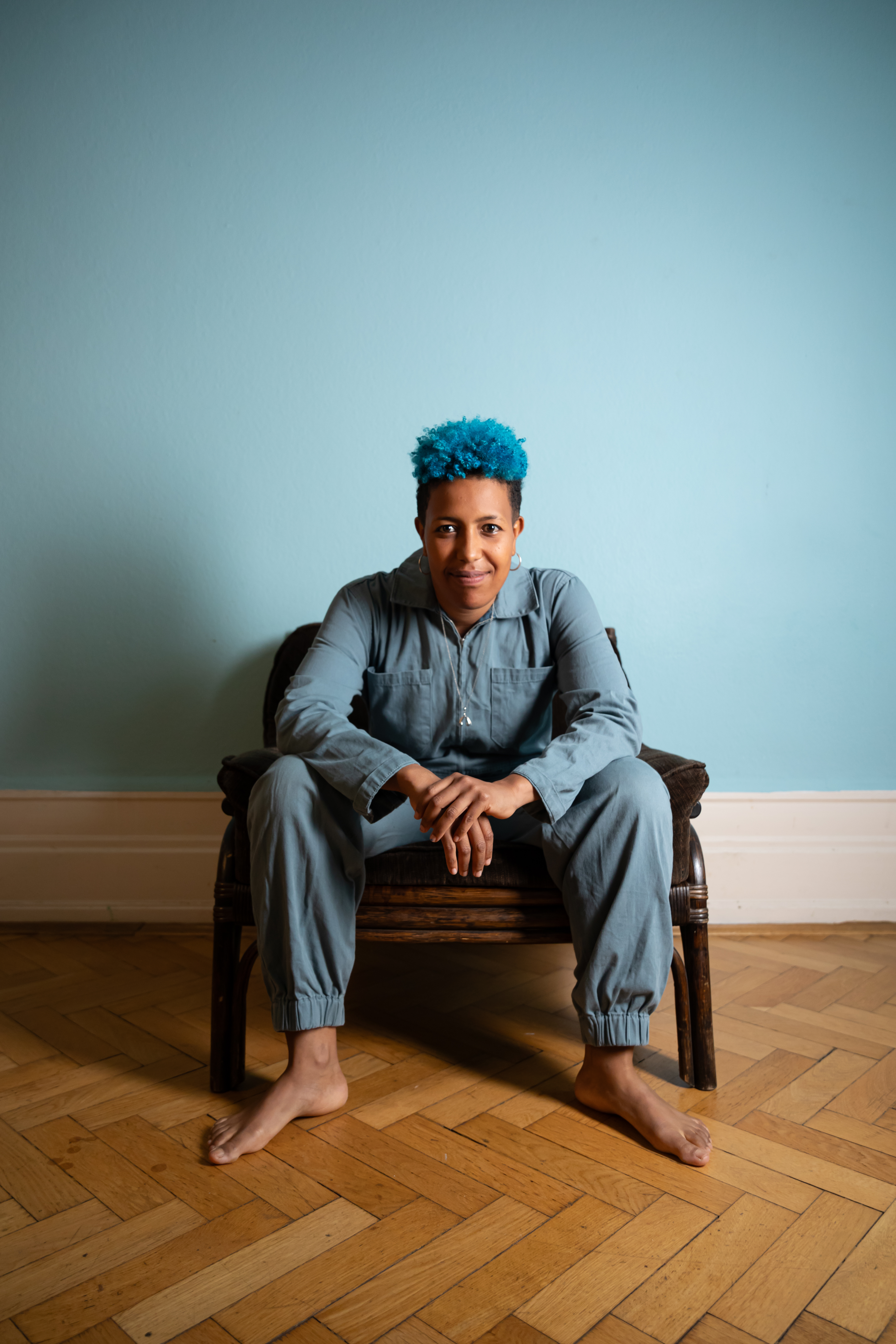
Nara Virgens
→ Curation / Production / Dance
How can dance become more inclusive? Nara Virgens talks about Emerging Change, a festival that centers Queer, Trans and BIPOC voices while fostering community, care and collective change.
Aside their work as production manager at Tanzfabrik Berlin Bühne, Nara Virgens is co-initiator, co-director and co-curator of the festival Emerging Change. This initiative rose from a shared need that choreographer Makisig Akin and Nara had for an artistic space where voices of Queer, Trans, Black, Indigenous, People of Color dance artists are centered. Nara and me meet up at Tanzfabrik to talk about their mission for a more inclusive dance field.
Coming from Brazil to Germany when they were seventeen, Nara learnt German in no time and went studying Cultural Studies in Frankfurt (Oder). While they appreciated the University, with its exciting study program and easy access to professors and administrators, Berlin was pulling.
“I was actually quite scared of Frankfurt (Oder). It felt so empty, and depressing, and we had stories of aggression. I didn’t feel safe there. So I moved to Berlin after three months in Frankfurt (Oder) and commuted back and forth. The vibrancy and the culture of Berlin drew me in, I went to musea, concerts and theaters all the time.”
Their first job in Berlin was at Ballhaus Naunynstrasse, where they became the stage design assistance of a production. Even though knowledge of design was limited, they enjoyed running around the city and getting all the material. And they got acquainted with the job of a production manager.
“I saw how their production manager made everything happen behind the scenes, knew what was going on and kept the overview. I thought: I want to do that! My strength really lies in the interrelational part of the job. When I was freelancing I worked more on performance production and for example with Meg Stuart and Jule Flierl I could be part of the creative process.”
Since 2021, Nara works at Tanzfabrik in production but also more and more in curation, for example in the residency programs of Tanzfabrik. This aligns with the work they are developing for Emerging Change. Makisig and Nara lived together in a WG and started sharing their ideas in the kitchen. They had a lot of experiences in common.
“When I’m in a theatre space I automatically check the room. Am I the only BIPOC person in the space? Many times the answer is yes. That is violent, because when we step out into the city, we see all kinds of people in different shapes and forms, with different backgrounds and ethnicities.”
They started to think how they, with all their love for their work and performances, could have more impact in reshaping the scene. A place where BIPOC artists and audiences can come together, and that gives opportunities to connect, help each other and re-energize one and other. Starting from the concept of FUBU, For Us By Us, they implemented artistic strategies to nurture artistic collaboration, non-hierarchical artistic mentorship, community exchange, and a care-based working culture.
“At every level of our work, we collaborate as a group of people—many of whom are BIPOC, queer, and have access needs that must be acknowledged and supported. Society is very ableist and that is ingrained in our bodies as well. Because we are so diverse in the team, we become more sensitive to the needs different people have. We support each other, and that creates a real sense of community in the team.”
The first edition of Emerging Change took place in 2024 and impressively created new working modes on different levels. In a six week program it matched young artists with more experienced mentors, it created opportunities for performing artists to visit each others works and workshops, it focused on community and accessibility, with awareness teams and video’s to share info on the locations beforehand. The idea was to spread across the city like a network of mushrooms, decentralized, growing through partnerships with organizations such as Trans* Inter* Queer Community & Health Centre Casa Kuà and GLADT e.V., a self-organization by and for Black, Indigenous, and People of Color (BIPOC) lesbian, gay, bi+, trans, inter* and queer people communities. Rather than centering a single location, the festival supported and amplified existing initiatives, with a shared focus on embodied practices and lived experience.
“When you come in a space where you recognize yourself in others it already relaxes your nervous system. That opened up ways to more embodied practices. For us it was important to start and end the festival with the body. People not only came to see performances, but started for example with a Shiatsu workshop by Zem*u Huber followed by a conversation about Rest practices and Grief. They get to know the artists doing workshops with them. Last time we ended the festival with a collective meditation dreaming together, guided by Isabel Dikumbi. In this dystopian world, with so many iPhones, computers, and isolation there is more and more need for live encounters and deeper connections. That’s why creating a space where there are drinks and food, and people feel invited, is so important to us. Some people from the neighborhood came to the Uferstudios for the first time, and thanked us deeply for bringing people together like that.”
The upcoming edition centers the topic of Pleasure & Survival. Sustaining the intensity and momentum of a six-week festival proved challenging, so the festival is shorter (3 weeks) and care is more implemented for Nara and Makisig and the rest of the team. The relevance of the festival though is stronger than ever. In this current world, where extreme right-wing ideologies and politics are so present and impactful, we need to fight back. Emerging Change actively sets a concrete example for change.
“Emerging Change is a platform for recovery. It aims to give us energy, rest and power. I hope we can create many more editions.”
The next edition of Emerging Change is from 2 till 22 November 2026.
www.emergingchange.org